
Mountain Gorilla Reproduction – Mating Behaviors & Life Cycle
With not more than 1,064 individuals remaining in the wild, mountain gorillas are some of the rare and endangered primate species only found in the tropical rainforests of three countries, Uganda, Rwanda and Democratic Republic of Congo.

Mountain gorillas are a subspecies of the Eastern Gorilla, physically characterized by their large body size. Males weigh about 400 pounds, and females weigh about 200 pounds. They have longer, thicker, and darker fur, a saddle-shaped patch of silver hair on their backs, unique nose prints, strong teeth, broad foreheads, and opposable thumbs.
Mountain gorillas live in the rainforest mountainous areas at altitudes of 8,000 to 13,000 feet. These huge primates feed on vegetation such as leaves, shoots, roots, stems, fruits and bamboo.
Due to poaching, diseases, and habitat loss, mountain gorillas are one of the most endangered primates on the planet.
Mountain Gorilla Production and Mating Habits
Female mountain gorillas reach sexual maturity at the age of 10 t 12 years, although they can have their first ovulation at 8 years. Males reach sexual maturity at the age of 11 to 13 years.
Usually females produce on infant or sometimes twins after a period of 4 years. This is because female gorillas wait until the infant is fully independent, which happens around the age of 4. Female gorillas are in heat for 1 to 2 days in a month and they attract males through body movements, uninterrupted eye contact and puckering lips.
Gorillas do not have a specific mating season and can mate at any time of the year.
The gestation period for mountain gorillas is about 8.5 months. After giving birth, they wait for 4 years to conceive again until the infant is fully grown. This means they have a low reproduction rate.
Female mountain gorillas have a menstrual cycle of about 28 years, and the fertile period is usually 3 days when they can easily conceive.
Mountain gorillas are polygamous, the dominant silverback can mate with all the females in the family. Mountain gorillas have a low birth rate, which greatly affects their population growth.

Sexual Maturity in Mountain Gorillas
Female gorillas reach sexual maturity around 10 – 12 years, while males become sexually active after becoming silverbacks, usually at 11 – 13 years. Young gorillas pass through stages of juvenile and adolescent development before becoming fertile adults.
Courtship and Mating Behavior
Often courtship begins with the female initiating by making gestures or sounds. The silverback may respond with subtle vocalizations or physical displays. There is no fixed breeding seasons, gorillas can mate year-round.
Reproductive Cycle
The female estrous cycle is around 28 – 33 days. Fertility peaks during a 1-2 day window. Unlike some primates, gorillas show subtle signs of estrus. During this time, mating frequency increases.
Copulation and Frequency
Copulation in gorillas is brief and occurs multiple times during a female’s fertile period. The silverback dominates mating opportunities, though subordinate males may mate occasionally with the females.
Parental Investment and Weaning
Mothers carry and nurse their infants for over 2 years. Weaning begins around 2.5 – 3 years. Female gorillas have a long interbirth interval 4+years, limiting reproductive output.
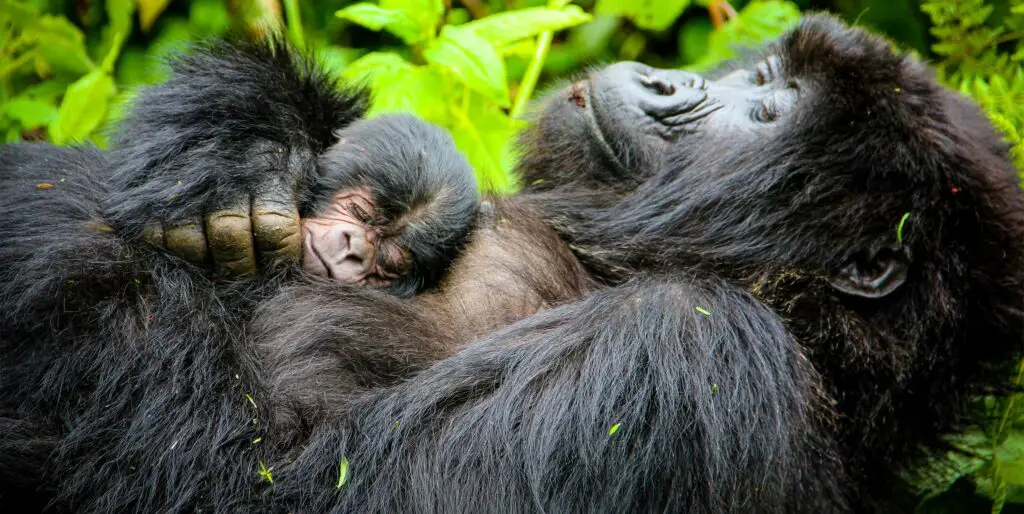
Breeding Intervals and Lifetime Reproduction
Due to the long dependency and recovery time, a female may only have 5-6 offspring in her life time. This slow reproductive rate makes population recovery difficult.
Threats to Gorilla Reproduction
The major threats to gorilla reproduction are infant mortality, diseases, habitat loss, and group takeovers leading to infanticide. Young females often migrate to avoid in breeding, while new males may kill existing infants to mate sooner.
Conservation Implications
Conservation must protect female reproductive health of both sexes and maintain stable, connected habitats. Preventing disruptions and poaching is critical to ensuring successful gorilla reproduction.
In conclusion: Mountain gorilla reproduction and mating is influenced by their structure, slow maturity, and parental investment. Understanding these aspects is vital for effective conservation. With their slow reproductive cycle, any threat can cause lasting harm to populations.


