Uganda and Rwanda are the best countries in the world for mountain gorilla trekking, both with great safari options. Gorilla Trekking in Rwanda is limited to Volcanoes National Park for a conservation focused experience.
Bwindi impenetrable National Park in Uganda has four gorilla trekking sectors but can be a harder trekking option due to the terrain.
With only 1,060 mountain gorillas remaining in the world, having the opportunity to see them in their natural habitat is unfortunately very rare. This is what makes it all the more special.
Which is one of these two East African countries should you visit for the ultimate gorilla trekking experience? Is an often asked question by every traveller. To help you choose between these two countries, we have pitted Uganda and Rwanda against each other to answer the ultimate question. Gorilla Trekking: Uganda or Rwanda?
Uganda
Described as The Pearl of Africa by Winston Churchill, Uganda is often overlooked by travellers. Bwindi Impenetrable National Park’s lush jungle and tropical forests are home to the highest concentration of primates on earth. Around 20 habituated gorilla families around in Bwindi with each gorilla family limited to a maximum of 8 visitors per day.
Mountain gorillas are constantly on a move, so it is hard to narrow down just on area in which to track them. As a result, the total time you spend on gorilla trekking experience can be from half an hour to eight hours and more.
Uganda is more suited for adventurous travellers, as Bwindi’s terrain is such that you start your trek on high ground before descending into the valley to see the gorillas, ending with an arduous climb at the end of the day. Slopes can often b steep and there are no trails, giving Bwindi Impenetrable National Park its impenetrable reputation.
Weather in Uganda is also unpredictable, even during the dry seasons, so rain can make the trails muddy and slippery.
Tackling challenging conditions is often worth it, though, as Bwindi Impenetrable National Park is home to an incredible 79 mammal species, 160 species of trees and 100 species of ferns. Opportunities to spot giant forest hogs, forest elephants and several small cats while gorilla trekking will no doubt make your visit worthwhile.
Mgahinga Gorilla National Park is another destination for gorilla trekking in Uganda, the park’s small size means that the gorilla family residing here is slightly more elusive. Mgahinga is part of the Great Volcanoes Conservation Area shared by Rwanda’s Volcanoes National Park and Virunga National Park in Democratic Republic of Congo. The park spreads across three inactive volcanoes (part of the Virunga Volcanoes Chain) – Sabinyo, Gahinga and Muhabura making its 34 square kilometres landscape incredibly dramatic.
Because it can be slightly more difficult to find the gorilla family at Mgahinga, it is great to spend your time here doing other safari activities as well, such as golden monkey trekking, hiking one of the three volcanoes or connecting with the indigenous Batwa Tribe.
Rwanda
Crowned – The land of a thousand hills, Rwanda’s rolling green savannahs and tropical rainforests provide the perfect backdrop or gorilla trekking. Gorilla sightings in Rwanda are got in Volcanoes National Park, the region has gentle slopes and open bush catering to all types of travellers. Volcanoes National Park was named by virtue of the fact that it is home to five of the eight volcanoes in the Virunga Mountains Massif. Combined with blanketed rainforests, open grassland and small lakes, the landscapes across Volcanoes National Park are worth visiting in and themselves.
Similar to Uganda, a maximum of eight tracking permits per gorilla family are allowed in Rwanda’s Volcanoes National Park so the forest is seldom too crowded. With 10 habituated gorilla groups, the time it takes to locate them is similar to that taken in Uganda’s Bwindi Impenetrable National Park and Mgahinga Gorilla National Park. However, Rwanda’s open environment lends itself to less arduous treks, making it more accessible than Uganda’s challenging terrain.
Where to stay?
Where to stay in Uganda?
There are several accommodation options to stay during your gorilla trekking in Uganda, these include
- Clouds Mountain Gorilla Lodge – situated on a ridge top in the heart of Bwindi, the lodge offers sweeping views over the forested Virunga Mountains. The property’s special feature is the terrace, as you are able to enjoy dinner with a backdrop of Mount Nyirangongo’s glowing lava lake.
- Mahogany Springs – this riverfront lodge combines exceptional service with a wonderful location. Highlights of Mahogany Springs include fresh produce grown on site, panoramic views from private balconies and open terracotta showers. For a more secluded feel, the presidential suite features two bedrooms and two bathrooms, complete with a spacious living room and private terrace.
- Sanctuary Gorilla Forest Camp – The camp boasts a very communal feel, with an outdoor campfire area set up for fellow guests to come together and swap stories.
- Mount Gahinga Lodge – The lodge is ideally placed in a prime location in the heart of Mgahinga Gorilla National Park, six stone and thatch bandas feature fireplaces and solar heated showers, giving it a cozy, authentic feel.
Where to stay in Rwanda?
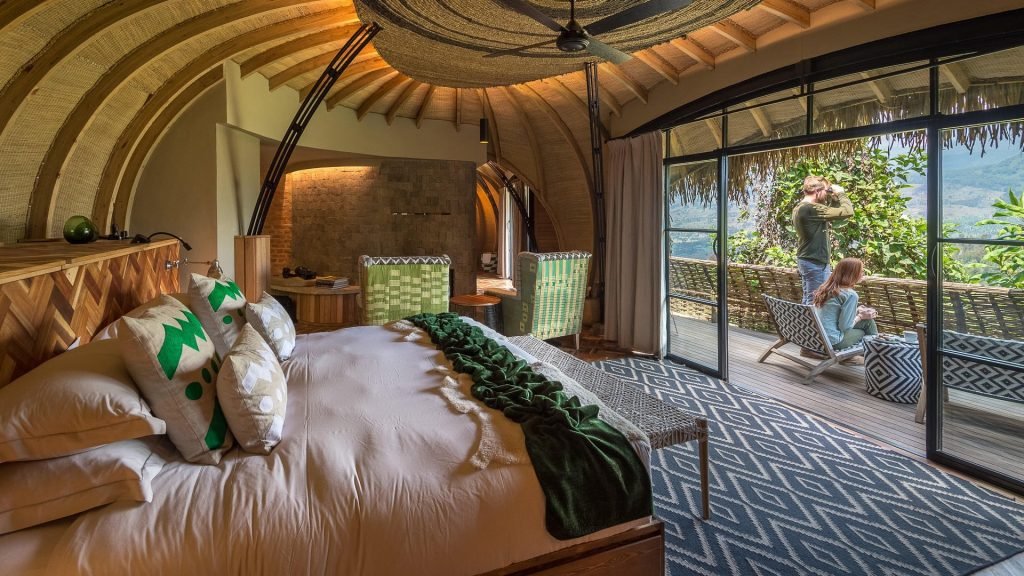
- Bisate Lodge – set amongst an eroded Volcanoes cone, the lodge’s six forest villas boast panoramic views across rolling hills and guided village walks amongst the local community. Bisate Lodge’s Villas provide an out of this world feel, with each room’s private deck facing the ethereal Mount Bisoke.
- Virunga Lodge – sitting atop a 2,300 metre hilltop overlooking twin lakes of Bulera and Ruhondo, the lodge is one of central Africa’s premier eco lodges. Virunga is environmentally conscious property, with en suite bathrooms running on solar hot water.
- Sabyinyo Silverback Lodge – set in the foothills of the Virunga Mountain, the lodge features eight spacious standalone cottages decorated in a homely fashion. The secluded location of Sabyinyo Silverback Lodge makes it a great choice for honeymooners, the location creates a private feel.
When to go for gorilla trekking?
Uganda
Uganda has an average altitude of around 1,000m and straddles the equator, which makes the heat rarely too intense, meaning you can visit year-round. However, the best time for gorilla trekking is between July and September. This period is a dry season coinciding with Uganda’s peak season, make sure you organise your permit and book your accommodation in advance. Only a limited number of 8 visitors per habituated gorilla group are permitted to visit the gorillas, so the forest is never too crowded.
Rwanda
Rwanda’s weather is variable, as the country has two dry seasons and two wet seasons. The dry seasons running between mid-December to early February and from June to September are ideal for gorilla trekking, since the forest terrain is not as treacherous as it tends to be during the rainy season months.
Drier temperatures also mean a low risk of contracting malaria. However, because Rwanda is equatorial, the weather is never predictable, so it is wise to include waterproofs on your packing list year round.
Which is the more sustainable option?
Uganda
Gorilla trekking experience in Uganda is well known for being a sustainable destination. On a 3 days Bwindi Gorilla Safari, you will be able to learn about the inspirational work of the Bwindi team and hear about how your travel to this region directly benefits an at-risk ecosystem.
Gorilla-based tourism benefits the local community too, with private guides from the local community able to make a living from leading gorilla treks in Bwindi Impenetrable National Park and Mgahinga Gorilla National Park.
Rwanda
Conservation is still a primary features in Rwanda. All the guided treks in Volcanoes National Park are led by expert naturalist guides, with every effort made to minimise impact on the gorillas’ natural habitat.
Volcanoes National Park, Rwanda’s leading tourist destination was put firmly on map by American primatologist Dian Fossey, who founded a centre to bring worldwide attention to the gorillas’ endangered status.
In conclusion: Choosing between Rwanda and Uganda for gorilla trekking depends on your travel style and preferences, as each destination offers exceptional mountain gorilla viewing.


